

BlueRitt vs Helium 10 vs Jungle Scout: Best Product Research Tool in 2026
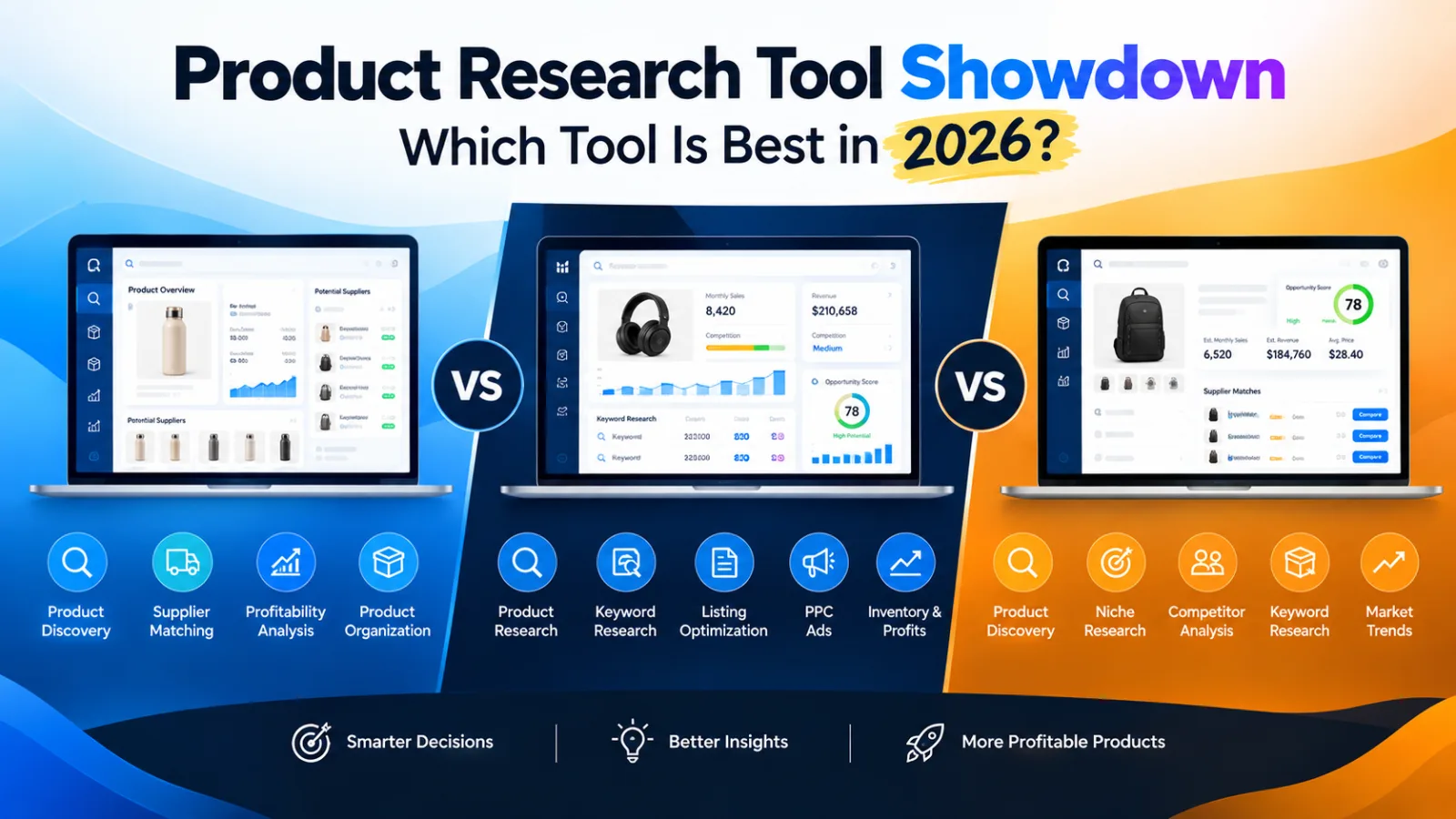
Finding a profitable product in 2026 is no longer just about discovering products with high sales. Sellers need to understand demand, competition, pricing, supplier options, profitability, market signals, and the risks involved before committing capital.
That is where product research software comes in.
Three platforms worth comparing in 2026 are BlueRitt, Helium 10, and Jungle Scout. However, they approach product research from different angles.
Helium 10 is heavily focused on Amazon sellers who need a broad suite of research, keyword, listing, advertising, and operational tools.
Jungle Scout is built around Amazon product discovery, market intelligence, keyword research, competitive analysis, and seller growth.
BlueRitt takes a broader product-sourcing approach by connecting product discovery with supplier matching, profitability analysis, social commerce intelligence, and product organization.
So, which one is best?
Quick answer
The best product research tool in 2026 depends on what you are trying to accomplish.
-
Best for Amazon-focused sellers and advanced Amazon workflows: Helium 10
-
Best for straightforward Amazon product and niche research: Jungle Scout
-
Best for connecting product research with sourcing and profitability decisions: BlueRitt
-
Best for sellers who want product discovery to lead directly into supplier and margin evaluation: BlueRitt
-
Best for a broad Amazon operating stack: Helium 10
-
Best for traditional Amazon opportunity discovery: Jungle Scout
The important distinction is that these platforms are not identical alternatives. They solve different parts of the product research problem.
BlueRitt vs Helium 10 vs Jungle Scout at a Glance
| Capability | BlueRitt | Helium 10 | Jungle Scout |
|---|---|---|---|
| Product discovery | ✅ | ✅ | ✅ |
| Product filtering | ✅ | ✅ | ✅ |
| Demand analysis | ✅ | ✅ | ✅ |
| Competition analysis | ✅ | ✅ | ✅ |
| Amazon-focused research | ✅ | ⭐⭐⭐ | ⭐⭐⭐ |
| Supplier matching | ⭐⭐⭐ | Limited / workflow-dependent | Limited / workflow-dependent |
| Product sourcing workflow | ⭐⭐⭐ | ⭐⭐ | ⭐⭐ |
| Profit/margin analysis | ⭐⭐⭐ | ✅ | ✅ |
| Product organization | ProductVault | Research/workflow tools | Product Tracker |
| Keyword research | Developing / broader intelligence approach | ⭐⭐⭐ | ⭐⭐⭐ |
| Social trend intelligence | ⭐⭐⭐ | ⭐⭐ | ⭐⭐ |
| Amazon business operations | ⭐⭐ | ⭐⭐⭐ | ⭐⭐⭐ |
| Supplier-to-product workflow | ⭐⭐⭐ | ⭐ | ⭐ |
| Best suited for | Product sourcing and decision-making | Amazon growth | Amazon product research and growth |
Important: Feature availability can vary by plan and marketplace. The comparison above focuses on the core positioning and workflow of each platform rather than treating every plan as identical.
What Is a Product Research Tool?
A product research tool helps sellers identify products that may have commercial potential before they invest money into inventory, manufacturing, marketing, or advertising.
A modern product research workflow typically involves answering several questions:
-
Is there demand for this product?
-
How competitive is the market?
-
What price are customers already paying?
-
How much revenue might the product generate?
-
What are competitors doing?
-
Can the product be sourced at a profitable cost?
-
What fees and operating costs will reduce the margin?
-
Is demand stable or seasonal?
-
Are customers showing interest outside Amazon?
-
Can the product realistically become a profitable business?
Traditional product research tools are particularly strong at answering the first five questions.
The bigger opportunity in 2026 is connecting research → sourcing → profitability → decision-making.
That is where the three platforms begin to differ.
What Is BlueRitt?
BlueRitt is an AI-powered eCommerce intelligence and product-sourcing platform designed to help sellers move from product discovery toward an actual sourcing decision.
Its product research workflow combines several stages that are often handled separately:
Discover → Validate → Source → Calculate → Save → Decide
BlueRitt Explorer brings product discovery, supplier matching, margin analysis, and product organization into one workflow.
Its research ecosystem includes:
-
IntelliScan for product discovery and market signals
-
SourceLink for supplier matching and sourcing evaluation
-
MarginMax for profitability and margin analysis
-
ProductVault for saving and organizing shortlisted products
The important distinction is that BlueRitt is not positioned simply as an Amazon keyword or sales-estimation platform.
It is designed around the broader question:
“Is this product worth sourcing and selling?”
That distinction matters because a product can have strong Amazon demand and still be a poor business opportunity if supplier costs, shipping, marketplace fees, competition, or margins make the economics unattractive.
What Is Helium 10?
Helium 10 is a broad eCommerce software platform with a particularly strong focus on Amazon sellers.
Its product research ecosystem includes tools such as Black Box and Xray.
Black Box allows sellers to search large product datasets using filters such as marketplace, category, price, competition, and estimated monthly revenue.
Xray provides product-level intelligence directly within Amazon and can surface information such as estimated sales, revenue, pricing, competition, and advertising signals.
Helium 10 goes beyond product research.
Its broader ecosystem includes:
-
Product research
-
Keyword research
-
Reverse ASIN analysis
-
Listing optimization
-
Rank tracking
-
PPC management
-
Inventory management
-
Profit analytics
-
AI-assisted workflows
-
Amazon education
That makes Helium 10 particularly attractive to sellers who want one Amazon-centric operating platform rather than a standalone product finder.
As of 2026, Helium 10's published pricing lists Platinum at $99/month when billed annually, with higher-tier plans designed for larger businesses.
What Is Jungle Scout?
Jungle Scout is one of the most established Amazon seller research platforms.
Its product research system includes Product Database, Opportunity Finder, Product Tracker, Category Trends, Keyword Scout, and its browser extension, among other tools.
Jungle Scout's Product Database allows sellers to search a large Amazon product catalog using filters related to categories, estimated sales, revenue, sales rank, pricing, and other criteria. Its current product page states that the database contains hundreds of millions of products.
Opportunity Finder is particularly useful for identifying niches based on demand, competition, search volume, seasonality, and other market signals.
Jungle Scout therefore remains particularly strong for sellers whose primary question is:
“Which Amazon product or niche should I investigate next?”
BlueRitt vs Helium 10 vs Jungle Scout: The Biggest Difference
The simplest way to understand the three platforms is to look at the decision they are helping you make.
Jungle Scout
“Which Amazon product opportunity should I investigate?”
Helium 10
“How can I research, launch, optimize, advertise, and operate my Amazon business?”
BlueRitt
“Is this product commercially attractive, where can I source it, and does the business case make sense?”
This difference is more important than comparing the number of filters or database sizes.
1. Product Discovery
Product discovery is the first stage of almost every eCommerce research process.
You begin with thousands or millions of possible products and attempt to narrow them down to a manageable shortlist.
BlueRitt
BlueRitt Explorer uses IntelliScan to help sellers discover product opportunities using signals such as demand, pricing, category information, ratings, and market indicators.
The goal is not simply to generate a list of products.
The goal is to move from:
Product idea → Market validation → Sourcing decision
That makes BlueRitt particularly useful for sellers who want to evaluate a product beyond Amazon demand.
Helium 10
Helium 10's Black Box is designed for large-scale product discovery.
Sellers can filter products according to criteria such as:
-
Price
-
Monthly revenue
-
Competition
-
Category
-
Product size
-
Reviews
-
Sales-related metrics
Helium 10 states that its research system provides access to a database of more than two million products across numerous marketplaces.
Jungle Scout
Jungle Scout's Product Database and Opportunity Finder are highly focused on Amazon opportunity discovery.
Opportunity Finder allows sellers to evaluate demand, competition, search volume, trends, seasonality, and niche scores.
Winner: Depends on the goal
For pure Amazon opportunity discovery, Jungle Scout and Helium 10 are extremely strong.
For product discovery that continues into sourcing and profitability, BlueRitt has a more integrated workflow.
2. Competition Analysis
Finding a product with high demand is not enough.
The real question is:
Can you realistically compete?
A product generating $100,000 in monthly revenue may look attractive until you discover that:
-
The top listings have thousands of reviews.
-
Large brands dominate the search results.
-
Advertising costs are high.
-
Product differentiation is difficult.
-
Suppliers have thin margins.
-
The market is saturated.
Helium 10's Xray provides search-result-level intelligence designed to help sellers understand sales, revenue, pricing, competition, and sponsored activity.
Jungle Scout also provides competitive intelligence through its research and tracking tools. Its current platform includes product-level competitive analysis and market intelligence.
BlueRitt approaches competition as one part of a larger product decision, combining market signals with pricing, sourcing, and profitability considerations.
Winner: Helium 10 for Amazon competitive intelligence
If your primary battlefield is Amazon search results, Helium 10 has a particularly deep competitive research workflow.
If competition is being evaluated alongside sourcing and margins, BlueRitt provides a broader decision framework.
3. Supplier Research and Sourcing
This is where the comparison becomes more interesting.
Finding a product is only half the job.
You still need to answer:
-
Who will manufacture it?
-
What is the unit cost?
-
What MOQ is required?
-
Can the supplier meet quality requirements?
-
What are shipping costs?
-
What lead times should you expect?
-
Can the supplier customize packaging?
-
Does the final landed cost support your target margin?
A product research platform that stops at demand data leaves the seller with another research process to complete.
BlueRitt
Supplier matching is one of BlueRitt's defining differences.
SourceLink is designed to connect product ideas with supplier options based on factors including product fit, pricing, quality, and delivery needs.
This creates a more connected workflow:
Product → Supplier → Cost → Margin → Decision
Helium 10
Helium 10 is primarily an Amazon growth platform. It offers extensive research, listing, keyword, advertising, and operational capabilities, but supplier matching is not the central organizing principle of its product research workflow.
Jungle Scout
Jungle Scout provides sourcing-related functionality within its broader Amazon seller ecosystem, but its core product research experience is still centered on discovering and validating Amazon opportunities.
Winner: BlueRitt
For sellers where supplier discovery is an essential part of product research, BlueRitt has the clearest workflow advantage.
4. Profitability and Margin Analysis
This is arguably the most important part of product research.
A product is not automatically profitable because it sells well.
Consider a hypothetical product:
Selling price: $30
Supplier cost: $9
Shipping and landed cost: $4
Marketplace fees: $5
Advertising: $4
Other operating costs: $2
Your actual contribution is:
$30 − $9 − $4 − $5 − $4 − $2 = $6
That is a very different business from one that appears to have a $21 gross margin.
This is why profitability should be calculated before sourcing, not after inventory arrives.
BlueRitt
BlueRitt's MarginMax is specifically designed to evaluate product cost, selling price, fees, gross profit, and net margin before a product moves further through the sourcing process.
This creates an important workflow:
Don't ask only whether customers want the product. Ask whether customers want it at a price that leaves you enough profit.
Helium 10
Helium 10 provides profit-related analytics as part of its broader seller platform.
This is valuable for established Amazon sellers who want profitability connected to their operational data.
Jungle Scout
Jungle Scout also includes sales and profitability analytics, particularly for sellers connecting their Amazon Seller Central data. Its current Catalyst platform includes Sales Analytics and Profit Tracker.
Winner: BlueRitt for pre-sourcing decisions
If the question is:
“Should I source this product?”
then an integrated product-cost → selling-price → fee → margin workflow is particularly valuable.
For sellers already operating an Amazon business, Helium 10 and Jungle Scout provide deeper post-launch analytics ecosystems.
5. Keyword Research
Keyword research is critical when Amazon is the primary sales channel.
It helps answer:
-
What are shoppers searching for?
-
How competitive are keywords?
-
Which terms generate demand?
-
Which keywords do competitors rank for?
-
What should appear in the listing?
-
Which terms could be targeted through advertising?
This is an area where Helium 10 and Jungle Scout have a significant advantage over a broader sourcing-first platform.
Helium 10 offers keyword research and reverse-ASIN workflows as part of its Amazon toolkit.
Jungle Scout also includes Keyword Scout and related keyword and listing optimization capabilities.
Winner: Helium 10 / Jungle Scout
For sellers whose product research process depends heavily on Amazon keyword intelligence, both platforms are stronger choices than using a sourcing-oriented tool alone.
6. Social and Emerging Demand Signals
Amazon sales data tells you what is already happening on Amazon.
But sellers increasingly need to understand what could happen next.
Consumer demand can emerge from:
-
TikTok
-
Instagram
-
YouTube
-
Google
-
Influencer content
-
Social communities
-
Seasonal events
-
Emerging consumer behavior
This is particularly important for products that have not yet become highly competitive on Amazon.
BlueRitt's broader platform positioning includes social commerce intelligence alongside product sourcing and market intelligence.
This can make the workflow more useful for sellers searching for early demand signals rather than simply copying products that are already successful.
Winner: BlueRitt for broader demand discovery
For pure Amazon search intelligence, Helium 10 and Jungle Scout remain stronger.
For a broader product-discovery perspective that includes social commerce signals, BlueRitt is more differentiated.
7. Product Organization
Product research becomes messy quickly.
A seller might discover:
-
50 potential products
-
15 promising niches
-
10 possible suppliers
-
7 products worth deeper analysis
-
3 products worth ordering samples for
Without organization, valuable research disappears into browser tabs and spreadsheets.
BlueRitt's ProductVault is designed to give sellers a dedicated place to save and organize shortlisted products.
The benefit is simple:
Research should produce a decision-ready shortlist, not an endless collection of browser tabs.
Jungle Scout provides product tracking and research workflows, while Helium 10 provides various research and operational workflows.
Winner: Tie, depending on workflow
Amazon sellers may prefer the deeper ecosystem inside Helium 10 or Jungle Scout.
Sellers focused on sourcing and product evaluation may find BlueRitt's research → shortlist workflow more natural.
8. Which Tool Is Best for Beginners?
Beginners usually make one major mistake:
They collect too much data before deciding what actually matters.
A beginner does not necessarily need hundreds of metrics.
They need to answer five questions:
-
Is there demand?
-
Is competition manageable?
-
Can I source it?
-
Can I sell it profitably?
-
Can I differentiate it?
Jungle Scout
Jungle Scout can be a strong starting point for beginners who are specifically entering Amazon FBA because its core workflows are centered around product and niche research.
Helium 10
Helium 10 becomes particularly attractive when the beginner wants to eventually build a more comprehensive Amazon operation involving keywords, listings, advertising, and analytics.
BlueRitt
BlueRitt can be particularly attractive to beginners who are thinking more broadly about eCommerce sourcing, especially if they want supplier and margin considerations included early in the research process.
Best beginner choice
Amazon-first beginner: Jungle Scout
Amazon-first beginner who wants a larger operating ecosystem: Helium 10
Sourcing-first eCommerce beginner: BlueRitt
9. Which Tool Is Best for Private Label Sellers?
Private-label sellers need more than demand data.
They need:
Demand + differentiation + sourcing + economics + branding
This is where the decision becomes less straightforward.
Helium 10 is particularly powerful for the Amazon side of private-label operations, including keyword research, listing optimization, competitor analysis, and advertising.
Jungle Scout provides a similarly Amazon-focused ecosystem for product discovery, market analysis, keywords, listings, and seller operations.
BlueRitt focuses more heavily on the front end of the business:
What should I source?
Who can supply it?
What will it cost?
What margin could I achieve?
Best combination for private-label decision-making
A sourcing-focused seller may find BlueRitt particularly valuable during the product selection and supplier evaluation stage, while Amazon-focused platforms can become especially valuable during launch and optimization.
10. Which Tool Is Best for Amazon FBA?
If Amazon FBA is your entire business model, the answer shifts.
Helium 10
Helium 10 has one of the broadest Amazon-focused ecosystems in this comparison.
Its platform extends from product research into keywords, listings, advertising, inventory, profits, and other operational functions.
Jungle Scout
Jungle Scout is also highly optimized for Amazon sellers.
Its current Catalyst platform includes product research, competitive intelligence, keyword and listing optimization, sales analytics, inventory capabilities, and advertising analytics.
BlueRitt
BlueRitt is better understood as a broader product sourcing and eCommerce intelligence platform rather than a direct replacement for every Amazon operational tool.
Winner: Helium 10
For an Amazon-only seller who wants one broad operating ecosystem, Helium 10 is the strongest overall choice of the three.
11. Which Tool Is Best for Product Sourcing?
This is where BlueRitt's positioning becomes most relevant.
Traditional product research often looks like:
Find product → estimate demand → check competition
A sourcing-centric workflow looks more like:
Find product → validate demand → identify suppliers → calculate landed economics → compare margins → shortlist
The second workflow reduces a major problem:
A product can be a winning product but a losing business.
Suppose Product A generates strong sales but costs $18 to source.
Product B generates slightly lower sales but costs $7 to source.
If Product B has substantially better margins, lower capital requirements, and easier differentiation, it may be the better business.
That is why product research should increasingly be viewed as commercial opportunity analysis, not simply product discovery.
Winner: BlueRitt
For sellers whose biggest challenge is moving from “interesting product” to “profitable sourcing opportunity,” BlueRitt has the clearest positioning.
12. BlueRitt vs Helium 10 vs Jungle Scout: Pricing Perspective
Pricing should never be evaluated independently from the workflow you are buying.
Helium 10 currently lists its Platinum plan at $99/month when billed annually, with Diamond listed at $279/month when billed annually and Enterprise starting at $1,499/month annually.
Jungle Scout's published pricing currently includes plans for smaller sellers and scaling businesses, with its pricing page positioning Catalyst for companies below $1 million in annual Amazon revenue and Cobalt for larger businesses.
The more important question is:
How much of your product research workflow does the subscription replace?
If a tool helps you discover products but still requires separate software for supplier research, margin calculations, trend research, and product organization, the effective cost of your research stack can become much higher than the subscription price suggests.
This is one reason an integrated workflow can be valuable even when comparing tools with different feature sets.
BlueRitt vs Helium 10 vs Jungle Scout: Strengths and Weaknesses
BlueRitt
Strengths
-
Product discovery
-
Supplier matching
-
Profitability analysis
-
Margin evaluation
-
Product organization
-
Broader eCommerce sourcing workflow
-
Social commerce intelligence
-
Product-to-supplier workflow
Limitations
-
Does not replace every Amazon keyword/PPC/listing tool
Best for
Sellers who want to find, source, evaluate, and organize profitable product opportunities.
Helium 10
Strengths
-
Advanced Amazon product research
-
Black Box product discovery
-
Xray competitive research
-
Keyword research
-
Reverse ASIN analysis
-
Listing optimization
-
PPC tools
-
Profit analytics
-
Inventory and operational tools
-
Broad Amazon ecosystem
Limitations
-
Can feel complex for beginners
-
Broader feature set means a steeper learning curve
-
Product sourcing is not the central organizing principle
Best for
Amazon sellers who want a comprehensive research, launch, optimization, advertising, and operations platform.
Jungle Scout
Strengths
-
Product Database
-
Opportunity Finder
-
Product Tracker
-
Keyword research
-
Amazon market intelligence
-
Product discovery
-
Competitive analysis
-
Beginner-friendly Amazon workflow
Limitations
-
More Amazon-centric
-
Less differentiated around supplier-to-margin workflows
-
Advanced business intelligence can require higher-tier products/plans
Best for
Amazon sellers who want a focused and established product research ecosystem.
The Real Winner Depends on Your Business Model
Instead of asking:
“Which product research tool is best?”
Ask:
“Which part of the product decision do I need the most help with?”
| Your primary goal | Best choice |
|---|---|
| Find Amazon products | BlueRitt |
| Discover Amazon opportunities | Jungle Scout |
| Advanced Amazon research | BlueRitt |
| Reverse ASIN research | Helium 10 |
| Amazon keyword research | Helium 10 / Jungle Scout |
| Amazon listing optimization | Helium 10 / Jungle Scout |
| PPC and Amazon operations | Helium 10 |
| Supplier matching | BlueRitt |
| Pre-sourcing margin analysis | BlueRitt |
| Product sourcing workflow | BlueRitt |
| Product discovery + sourcing | BlueRitt |
| Broader eCommerce opportunity research | BlueRitt |
| Amazon-only business management | Helium 10 |
A Better Product Research Workflow for 2026
The biggest change in product research is that sellers should stop treating product discovery as the final answer.
A better workflow is:
Step 1: Discover
Find products with promising demand and market signals.
BlueRitt IntelliScan can be used for this stage.
Step 2: Validate
Look at:
-
Demand
-
Competition
-
Pricing
-
Reviews
-
Market saturation
-
Trends
-
Customer interest
The goal is to determine whether the opportunity deserves further research.
Step 3: Source
Find potential suppliers and compare:
-
Product fit
-
Unit cost
-
MOQ
-
Quality
-
Delivery
-
Customization
-
Supplier reliability
This is where BlueRitt SourceLink becomes relevant.
Step 4: Calculate
Don't stop at selling price minus supplier cost.
Calculate:
Revenue − Product Cost − Shipping − Marketplace Fees − Advertising − Operating Costs = Contribution Profit
Then calculate:
Net Margin = Contribution Profit ÷ Revenue × 100
BlueRitt's MarginMax is designed around this stage.
Step 5: Compare
Never evaluate a product in isolation.
Compare several candidates based on:
-
Demand
-
Competition
-
Supplier cost
-
Potential selling price
-
Estimated margin
-
Capital requirements
-
Differentiation potential
-
Trend strength
Step 6: Shortlist
Move only the strongest opportunities into your active product pipeline.
BlueRitt ProductVault is designed for this organization stage.
Step 7: Launch
Once the product passes the commercial test, move into:
-
Branding
-
Packaging
-
Listing development
-
Keyword optimization
-
Advertising
-
Inventory planning
-
Launch strategy
This is where specialized Amazon platforms such as Helium 10 or Jungle Scout can become especially valuable.
Why Product Research Alone Is No Longer Enough
The eCommerce market has become significantly more competitive.
A product that worked three years ago may not work today.
A product with strong sales may have:
-
Too many competitors
-
Rising advertising costs
-
Falling prices
-
Increasing supplier costs
-
Low differentiation
-
Poor margins
-
High return rates
-
Short-lived demand
Therefore, the definition of a “winning product” has changed.
Old definition
A product with high demand and low competition.
Better 2026 definition
A product with validated demand, manageable competition, viable sourcing economics, sustainable margins, and enough differentiation to build a defensible business.
That is the fundamental difference between product discovery and product intelligence.
BlueRitt vs Helium 10 vs Jungle Scout: Final Verdict
There is no universal winner.
The three platforms are strongest in different areas.
Choose BlueRitt if:
You want to connect product discovery, supplier research, profitability analysis, and product organization in a single workflow.
BlueRitt is especially compelling when your biggest question is:
“Should I actually source this product?”
Choose Helium 10 if:
Your business is primarily Amazon-focused and you want a comprehensive ecosystem covering product research, keywords, competitors, listings, advertising, profits, inventory, and operations.
Choose Jungle Scout if:
You want an established Amazon-focused platform centered around product discovery, niche research, demand validation, competitive analysis, keywords, and seller growth.
So, Which Product Research Tool Is Best in 2026?
For Amazon-first sellers, Helium 10 and Jungle Scout remain two of the strongest choices.
For sellers who want a broader product sourcing and commercial evaluation workflow, BlueRitt offers a different approach.
The biggest distinction is not simply the size of a product database.
It is what happens after you find the product.
If your workflow ends with:
“This product sells well.”
you have completed product research.
If your workflow continues with:
“Who can supply it?” → “What will it actually cost?” → “What margin can I achieve?” → “Is the opportunity worth pursuing?”
you are doing product intelligence.
And in 2026, that distinction can make the difference between finding a popular product and finding a profitable business opportunity.
Frequently Asked Questions
Is BlueRitt better than Helium 10?
Neither platform is universally better.
Helium 10 is stronger for sellers who need a comprehensive Amazon-focused ecosystem covering product research, keywords, listings, advertising, and operations.
BlueRitt is differentiated around connecting product discovery with supplier matching, margin analysis, and product organization.
Is BlueRitt better than Jungle Scout?
It depends on the seller's objective.
Jungle Scout is particularly strong for Amazon product and niche research.
BlueRitt is designed around a broader product sourcing workflow that connects product discovery, supplier evaluation, profitability analysis, and product organization.
Which is better for Amazon FBA: Helium 10 or Jungle Scout?
Both are strong Amazon-focused platforms.
Helium 10 has a particularly broad ecosystem covering product research, keywords, listings, advertising, profits, and operations.
Jungle Scout is particularly strong for product discovery, opportunity research, competitive intelligence, and Amazon seller workflows.
The better choice depends on whether your priority is Amazon operations and optimization or product and niche discovery.
Which tool is best for finding profitable products?
There is an important distinction between finding products with high sales and finding products with attractive profit potential.
Helium 10 and Jungle Scout are strong for identifying Amazon products with demand and market potential.
BlueRitt adds supplier and margin considerations to the product research workflow, making it particularly useful when profitability needs to be evaluated before sourcing.
Can BlueRitt replace Helium 10?
Not necessarily.
BlueRitt and Helium 10 have different core strengths.
Helium 10 is a broad Amazon seller platform.
BlueRitt focuses more heavily on product discovery, sourcing intelligence, supplier matching, profitability, and product organization.
For some sellers, they can be complementary rather than direct substitutes.
Can BlueRitt replace Jungle Scout?
The same principle applies.
Jungle Scout is highly focused on Amazon product research and seller growth.
BlueRitt approaches the problem from a broader sourcing and commercial-intelligence perspective.
The right choice depends on whether Amazon research or end-to-end product sourcing is the central requirement.
What should I look at before choosing a product?
At minimum, evaluate:
-
Demand
-
Competition
-
Selling price
-
Supplier cost
-
Landed cost
-
Marketplace fees
-
Advertising costs
-
Expected profit
-
Net margin
-
Seasonality
-
Customer reviews
-
Differentiation potential
-
Supplier reliability
-
Market trends
A product should pass both the market test and the business-model test before you invest heavily in it.
What is the best product research strategy in 2026?
The strongest approach is not to rely on one metric.
Use a multi-stage workflow:
Discover → Validate → Source → Calculate → Compare → Shortlist → Launch
The objective is not to find the product with the highest sales.
The objective is to find a product with sustainable demand and attractive economics.
Final Takeaway
Helium 10, Jungle Scout, and BlueRitt should not be viewed as identical products.
They represent three different approaches to eCommerce intelligence:
Jungle Scout:
Product and niche discovery for Amazon sellers.
Helium 10:
A comprehensive Amazon research and growth ecosystem.
BlueRitt:
Product discovery connected to sourcing, supplier intelligence, profitability, and decision-making.
For sellers building an Amazon-only business, Helium 10 or Jungle Scout may be the more natural starting point.
For sellers asking a broader question—
“What should I source, who should I source it from, and will it actually make money?”
—BlueRitt's workflow is built around that decision.
The future of product research isn't simply finding products faster. It's making better product decisions before you spend money.
Start exploring your
next product opportunity
Use BlueRitt to evaluate product demand, compare suppliers,
and estimate profit
so you can move forward with confidence.
Start finding your next product today
What You’ll Get
- Product demand insights
- Supplier matching
- Profit estimation tools
- Structured product research workflow
Tell us more about your project
Share your project details with us, and we'll respond promptly.